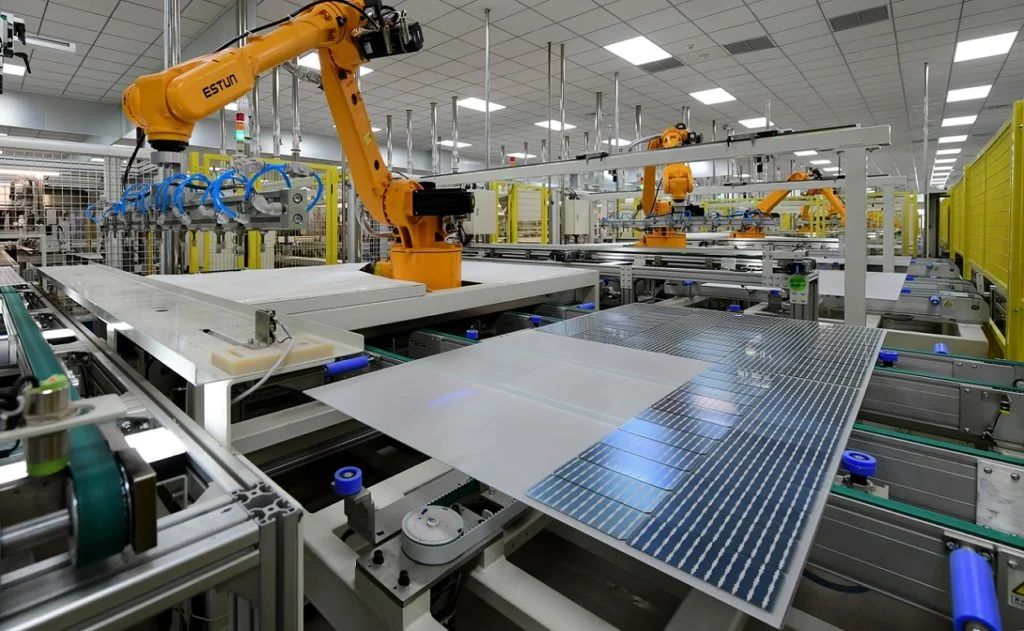
China moves to curb solar technology exports, testing world’s clean-energy supply chain
BEIJING: China has proposed export controls on 12 technologies used to manufacture solar equipment, a step that could complicate foreign efforts to build advanced panel factories and reinforce Beijing’s grip on the global photovoltaic industry.
China’s Ministry of Commerce announced the proposal on Friday as part of a broader revision of its technology export-control catalogue that also covers artificial intelligence and biotechnology. The public consultation will close on Nov. 15, and exporters must already register certain overseas technology transfers while the catalogue is updated.
What Would Be Restricted
Beijing would ban exports of technologies for making some thin silicon wafers, perovskite and tandem solar cells, and large-scale fluidized-bed polysilicon production. It would restrict — but not prohibit — exports of advanced cell-making technologies including TOPCon, heterojunction (HJT) and XBC.
Perovskite and tandem cells are next-generation designs intended to convert more sunlight into electricity, while fluidized-bed polysilicon production can be less expensive and more energy-efficient than the conventional Siemens process.
The ministry said the measures are intended to prevent technologies from being “improperly disseminated” while preserving normal international scientific and technological cooperation. It cited growing use of photovoltaic technologies in sensitive fields including aerospace and national defense.[reuters]
China’s Outsized Role
The proposal comes from the country that dominates nearly every stage of solar manufacturing. The International Energy Agency says China’s share across polysilicon, ingots, wafers, cells and modules exceeds 80%, and that its share of global polysilicon, ingot and wafer production is set to approach 95% based on capacity under construction.
More recent IEA analysis puts China at about 85% of solar supply-chain production capacity, including 95% of PV wafer capacity.[iea]
China’s export scale is enormous. Chinese customs data cited by industry publication PV Tech show the country shipped more than 235 gigawatts of solar modules in 2024, while solar-product export value exceeded 200 billion yuan for a fourth consecutive year.[pv-tech]
The value of those shipments has fallen even as volumes rise because of a global price glut. Analysis by the Federal Reserve Bank of New York estimates China’s solar-panel export revenue declined 40% between 2022 and 2025, from $46 billion to $28 billion.
Impact on the Global Solar Boom
The immediate effect would likely be felt less in finished-panel imports than in countries trying to manufacture advanced panels themselves. Restricted processes and equipment could make it harder for overseas producers to obtain Chinese know-how for high-efficiency cells, particularly perovskite-tandem and HJT technologies.
For China-reliant countries, the measures could slow plans to leap directly into frontier manufacturing. Europe, which imported 98% of its solar panels from China in 2024 according to Eurostat, would remain dependent on Chinese modules even as it seeks greater industrial autonomy.
But the controls could also accelerate localization. The IEA has found that industrial policies and trade measures in the United States, India and the European Union could reduce China’s share of PV manufacturing capacity from 80%–95% to 75%–90%, and its share of production from 75%–90% to 60%–75% by 2027 if import-limiting policies persist.
A Double-Edged Strategy
Analysts view the move as consistent with Beijing’s earlier reported consideration of limits on advanced solar-equipment exports to the United States, including HJT technology. Reuters reported in April that Chinese officials had held initial talks with equipment suppliers about potential curbs, though no rule had then been finalized.
Beijing has also reportedly curbed solar-manufacturing technology exports to India as New Delhi tries to expand domestic production and reduce reliance on Chinese suppliers.
For importers, the short-term risk is uncertainty rather than an immediate panel shortage: China still has ample production capacity, and the IEA says global capacity in 2024 could have produced more than twice the solar modules actually deployed.[iea]
For governments seeking factories rather than merely panels, however, the message is sharper: access to China’s most advanced production technology may become conditional, licensed or unavailable. That could raise costs and delay some projects, but it may also give policymakers a stronger justification for subsidies, joint ventures and domestic supply-chain investment.[reuters][iea]
The proposal remains open for comment and has not yet taken effect. Its final scope — and whether Beijing grants licenses for legitimate overseas transfers — will determine whether it primarily slows the global solar buildout or speeds the diversification of its manufacturing base.